

What Are Some Differences Between The Makeup Of Congress And The General Public
Introduction
The U.S. Constitution parcels out foreign relations powers to both the executive and legislative branches. It grants some powers, similar command of the war machine, exclusively to the president and others, like the regulation of foreign commerce, to Congress, while still others it divides among the ii or simply does non assign.
More From Our Experts
The separation of powers has spawned a great bargain of debate over the roles of the president and Congress in foreign affairs, as well as over the limits on their respective authorities. "The Constitution, considered simply for its affirmative grants of ability capable of affecting the upshot, is an invitation to struggle for the privilege of directing American foreign policy," wrote constitutional scholar Edward S. Corwin in 1958.
More on:
Us
Heads of Land and Government
Military machine Operations
Foreign policy experts say that presidents have accumulated power at the expense of Congress in recent years every bit function of a pattern in which, during times of state of war or national emergency, the executive branch tends to eclipse the legislature.
Friction by Design
The periodic tug-of-war between the president and Congress over foreign policy is non a by-production of the Constitution, but rather, ane of its core aims. The drafters distributed political power and imposed checks and balances to ward off monarchical tyranny embodied by Britain's Male monarch George III. They besides sought to remedy the failings of the Articles of Confederation, the national lease adopted in 1777, which many regarded every bit a grade of legislative tyranny. "If there is a principle in our Constitution, indeed in whatsoever free Constitution, more sacred than any other, it is that which separates the legislative, executive, and judicial powers," wrote James Madison, U.South. representative from Virginia, in the Federalist papers.
Many scholars say there is much friction over strange diplomacy because the Constitution is peculiarly obscure in this surface area. At that place is non the intrinsic segmentation of labor betwixt the two political branches that in that location is with domestic affairs, they say. And because the judiciary, the third co-operative, has generally been reluctant to provide much clarity on these questions, constitutional scuffles over foreign policy are probable to endure.
More From Our Experts
Powers of Congress
Article I of the Constitution enumerates several of Congress'due south foreign diplomacy powers, including those to "regulate commerce with foreign nations," "declare war," "raise and back up armies," "provide and maintain a navy," and "brand rules for the government and regulation of the land and naval forces." The Constitution likewise makes 2 of the president's strange affairs powers—making treaties and appointing diplomats—dependent on Senate blessing.
Across these, Congress has general powers—to "lay and collect taxes," to draw coin from the Treasury, and to "brand all laws which shall exist necessary and proper"—that, collectively, allow legislators to influence well-nigh all style of foreign policy issues. For case, the 114th Congress (2015–2017) passed laws on topics ranging from electronic surveillance to North korea sanctions to edge security to wildlife trafficking. In one noteworthy example, lawmakers overrode President Barack Obama's veto to enact a law assuasive victims of international terrorist attacks to sue foreign governments.
More on:
U.s.a.
Heads of Country and Authorities
Military Operations
Congress also plays an oversight office. The annual appropriations process allows congressional committees to review in detail the budgets and programs of the vast military and diplomatic bureaucracies. Lawmakers must sign off on more than a trillion dollars in federal spending every year, of which more than half is allocated to defense and international affairs. Lawmakers may also stipulate how that coin is to be spent. For instance, Congress repeatedly barred the Obama administration from using funds to transfer detainees out of the war machine prison at Guantanamo Bay.
Congress has wide authority to conduct investigations into particular strange policy or national security concerns. High-contour inquiries in contempo years take centered on the 9/xi attacks, the Cardinal Intelligence Bureau's detention and interrogation programs, and the 2012 set on on U.S. diplomatic facilities in Benghazi, Libya.
Furthermore, Congress has the power to create, eliminate, or restructure executive branch agencies, which it has oftentimes done later on major conflicts or crises. In the wake of Globe War 2, Congress passed the National Security Human action of 1947, which established the CIA and National Security Council. Post-obit the 9/xi attacks, Congress created the Section of Homeland Security.
Powers of the President
The president's dominance in foreign affairs, as in all areas, is rooted in Commodity II of the Constitution. The charter grants the officeholder the powers to make treaties and appoint ambassadors with the advice and consent of the Senate (Treaties require approval of two-thirds of senators present. Appointments require consent of a uncomplicated majority.)
Presidents too rely on other clauses to back up their foreign policy actions, particularly those that bestow "executive ability" and the office of "commander in main of the army and navy" on the office. From this linguistic communication springs a broad array of associated or "unsaid" powers. For example, from the explicit power to appoint and receive ambassadors flows the implicit potency to recognize foreign governments and deport affairs with other countries generally. From the commander-in-chief clause menses powers to use military machine strength and collect foreign intelligence.
Presidents too draw on statutory regime. Congress has passed legislation giving the executive additional authorization to deed on specific strange policy issues. For instance, the International Emergency Economic Powers Act (1977) authorizes the president to impose economic sanctions on strange entities.
Presidents too cite example police to support their claims of potency. In particular, ii U.S. Supreme Court decisions—United States. v. Curtiss-Wright Export Corporation (1936) and Youngstown Sheet & Tube Company v. Sawyer (1952)—are touchstones.
In the first, the court held that President Franklin D. Roosevelt acted within his ramble authority when he brought charges confronting the Curtiss-Wright Consign Corporation for selling arms to Paraguay and Bolivia in violation of federal constabulary. Executive branch attorneys oftentimes cite Justice George Sutherland's expansive estimation of the president's foreign affairs powers in that case. The president is "the sole organ of the federal government in the field of international relations," he wrote on behalf of the court. "He, non Congress, has the better opportunity of knowing conditions which prevail in foreign countries and especially is this true in fourth dimension of war," he wrote.
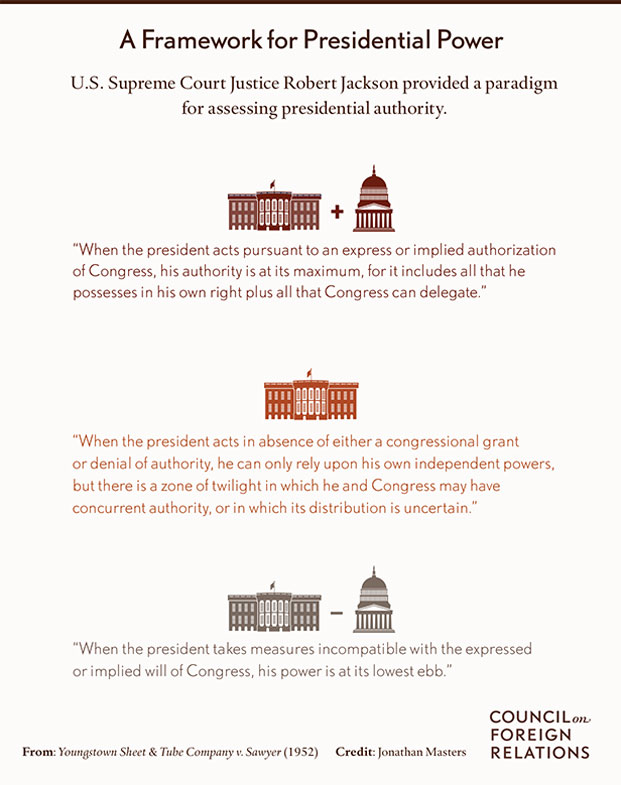
In the second case, the court held that President Harry Truman ran afoul of the Constitution when he ordered the seizure of U.S. steel mills during the Korean War. Youngstown is often described by legal scholars every bit a bookend to Curtiss-Wright since the latter recognizes broad executive authorisation, whereas the former describes limits on it. Youngstown is cited regularly for Justice Robert Jackson'south 3-tiered framework for evaluating presidential power:
Conflict Between the Branches
The political branches frequently cross swords over foreign policy, particularly when the president is of a different party than the leadership of at least one chamber of Congress. The following bug often spur conflict betwixt them:
Military operations. State of war powers are divided between the two branches. Merely Congress tin declare war, but presidents accept ordered U.S. forces into hostilities without congressional authorization. While at that place is general agreement that presidents can employ military force to repel an assail, there is much fence over when they may initiate the use of military force on their own authorization. Toward the end of the Vietnam War, Congress sought to regulate the use of war machine forcefulness by enacting the War Powers Resolution over President Richard Nixon'south veto. Executive branch attorneys have questioned parts of the resolution's constitutionality ever since, and many presidents have flouted information technology. In 2001, Congress authorized President George West. Bush to use military forcefulness against those responsible for the 9/11 attacks; and, in 2002, it approved U.Southward. military action confronting Iraq. Withal, in recent years, legal experts from both parties have said the president should have obtained additional authorities to use military forcefulness in Great socialist people's libyan arab jamahiriya, Iraq, and Syria.
Congress tin can as well use its "power of the purse" to rein in the president'due south armed forces ambitions, merely historians note that legislators practise not typically take activeness until nigh the end of a disharmonize. Moreover, lawmakers are often loath to be seen by their constituents as holding back funding for U.Southward. forces fighting away. During the Vietnam State of war, lawmakers passed several amendments prohibiting the apply of funds for combat operations in Vietnam and neighboring countries. Congress took similar measures in the 1980s with regard to Nicaragua, and in the 1990s with Somalia.
Foreign aid. Presidents take also aghast at congressional attempts to withhold economical or security help from governments or entities with poor human rights records. For instance, during the Obama administration, senior U.South. war machine commanders said that, while well-intentioned, restrictions on U.S. aid complicated other strange policy objectives, like counterterrorism or counternarcotics.
Intelligence. Congress began to claim a larger role in intelligence oversight in the 1970s, particularly later on the Church Commission uncovered privacy abuses committed past the CIA, Federal Bureau of Investigation, and National Security Agency. Congress passed several laws regulating intelligence gathering and established committees to supervise the executive branch's activities in areas including covert operations. Many presidents have protested these developments and claimed that Congress was encroaching on their prerogatives.
International agreements. The Senate has approved more than 1,600 treaties over the years, just it has also rejected or refused to consider many agreements. Later World State of war I, senators famously rebuffed the Treaty of Versailles, which had been negotiated by President Woodrow Wilson. More recently, a small-scale coalition in the upper chamber blocked ratification of the United nations Convention on the Law of the Body of water despite the support of both Republican and Democratic administrations. Political hurdles associated with treaties take at times led presidents to forge major multinational accords without Senate consent. For instance, the Paris Agreement on climate alter and the Islamic republic of iran nuclear agreement, both negotiated past President Obama, are non treaties. Thus, legal analysts say, future presidents could likely withdraw from them without congressional consent. The Constitution does not say whether presidents demand Senate consent to stop treaties.
Trade. The Constitution expressly grants Congress the power to regulate strange commerce, but lawmakers accept for decades provided presidents special authority to negotiate merchandise deals within established parameters. Renewal of this "fast track" trade promotion authority has become more controversial in recent years as trade deals have become more complex and the debates over them more partisan.
Immigration. Presidents are constitutionally leap to execute federal immigration laws, but there is considerable debate over how much latitude they have in doing and then. Many Republican lawmakers said the Obama administration ignored the law when it established programs shielding undocumented immigrants from displacement. For its role, the administration said that it had wide discretion to decide how to spend the government'south deficient resources on enforcement. More recently, many Democratic lawmakers said President Donald J. Trump overstepped his ramble and statutory authority when he attempted to block travelers from seven Muslim-bulk countries from entering the United States.
The Reluctant Courts
Federal courts, including the Supreme Court, weigh in from time to time on questions involving foreign affairs powers, just in that location are strict limits on when they may practice so. For ane, courts can but hear cases in which a plaintiff tin can both prove they were injured by the alleged actions of some other and demonstrate the likelihood that the courtroom can provide them relief. For instance, in 2013, the Supreme Court threw out a lawsuit challenging the constitutionality of an electronic surveillance program, ruling that the lawyers, journalists, and others who brought the suit did not have standing because the injuries they allegedly suffered were speculative.
Another form of judicial restraint turns on the "political question" doctrine, in which courts decline to accept sides on a major constitutional question if the judges say its resolution is best left to the president or Congress. For instance, in 1979, the Supreme Courtroom debated whether to hear a example brought past members of Congress against the administration of President Jimmy Carter. The lawmakers claimed that the president could non terminate a defense pact with Taiwan without congressional blessing. The court dismissed the case afterwards a bulk of justices found the underlying issue to be a political question, and thus exterior the scope of their review.
However, the Supreme Court has weighed in on several cases related to the detention of terrorism suspects at the U.Due south. military prison house in Guantanamo Bay. More recently, the court took on a dispute between the Obama administration and Congress over the recognition of Israeli sovereignty over Jerusalem. "Information technology is for the president lone to make the specific decision of what strange ability he volition recognize every bit legitimate," the courtroom held.
Trends and Prospects
Presidents have accumulated strange policy powers at the expense of Congress in contempo years, specially since the nine/11 attacks. The tendency conforms to a historical blueprint in which, during times of war or national emergency, the White House has tended to overshadow Capitol Hill.
Scholars note that presidents take many natural advantages over lawmakers with regard to leading on foreign policy. These include the unity of role, chapters for secrecy and speed, and superior data. "The verdict of history, in brusk, is that the substantive content of American foreign policy is a divided power, with the king of beasts's share falling usually, though by no means always, to the president," wrote Corwin, the legal scholar.
Some political analysts say Congress has abdicated its foreign policy responsibilities in recent years, faulting lawmakers in both parties for effectively standing on the sidelines as the Obama administration intervened militarily in Great socialist people's libyan arab jamahiriya in 2011 and in Syria starting in 2014. Lawmakers should emulate the activist measures Congress took to counterbalance in on foreign policy problems from the tardily 1960s to the early 1990s, they say. Policymakers can besides significantly alter executive branch behavior simply by threatening to oppose a president on a given strange policy outcome.
Additional Resources
In a series of blog posts, CFR's James G. Lindsay examines the sectionalization of state of war powers between Congress and the president in the context of the U.S.-led armed services intervention in Libya.
President Trump's strange policy proposals may spur Congress into taking a more active office than it has in recent years, writes political science professor Stephen R. Weissman in Foreign Affairs.
Source: https://www.cfr.org/backgrounder/us-foreign-policy-powers-congress-and-president
Posted by: cohenkeire1972.blogspot.com
0 Response to "What Are Some Differences Between The Makeup Of Congress And The General Public"
Post a Comment